The Rutgers AIAA recruits energetic, self motivated, high performing students from every discipline:
Come to the next scheduled event or contact an AIAA Officer. Begin participating in the many events, projects, and competitions we're engaged in. You'll also get a chance to interact with others whose interests and expertise may lie outside your experience. This multi-disciplinary exposure will serve you well throughout your career.
So come to an event. Talk, listen, engage, contribute...
"...and if you're not careful, you may learn something before it's done." -Bill Cosby
This altered version of the classic phrase embodies the principle which guides the activities of the Rutgers University AIAA Chapter. The nature of modern engineering requires a diverse set of skills for success.
Our group seeks to expose its members to the many disciplines involved in solving modern aeronautical and aerospace problems. We also actively seek to develop and widen the skill set of each individual; to help them each become a Jack of all Trades....
AIAA Executive Board members meeting.
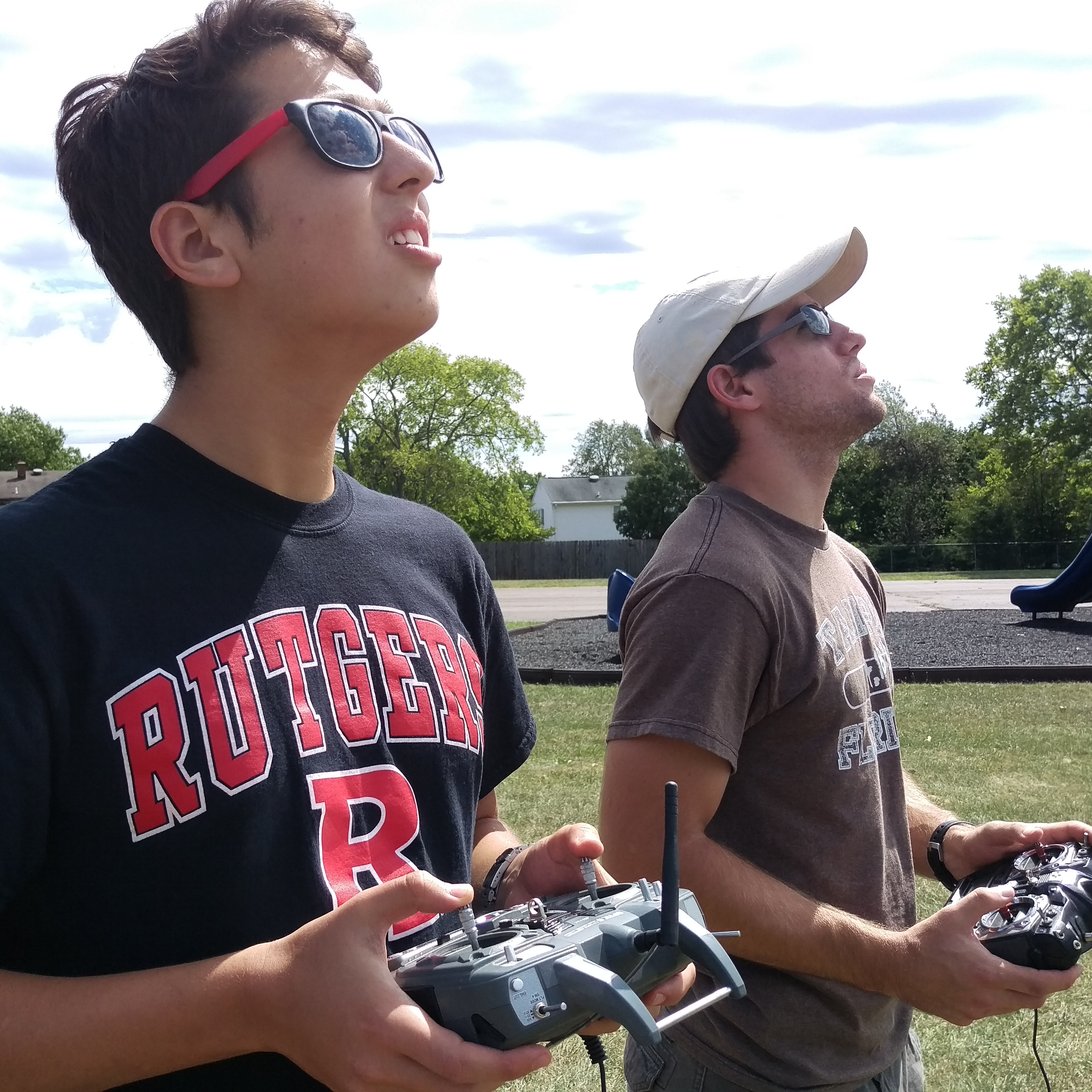
Maiden flight of side project R/C plane, the Piper J-3 Cub.
The Piper Cub nears completion and the maiden flight should take place within the week. Thanks are hereby officially conveyed to the many AIAA members who took up glue and X-Acto knife to assist in its construction. Hopefully they also gained some "feel" for the minimal use of materiel and maximum creativity in assembly that are the hallmark of aircraft structures. Email Paul ("pbonness" at eden) if you would like to be notified of the exact date and time of the flight (location for this first flight will probably be in the Livingston RAC parking lot, early in the morning or just before sunset). -Paul
AIAA Airplane construction update. Putting the wings together now. Found a way to simplify the attachment of the wings to the fuselage and eliminated about 8oz of weight in doing so. Tail boom assembly has finally progressed beyond theoretical stage (all tail surfaces are built, just the boom connecting them to the fuselage is left). Engine is mounted, all nose components installed and connected. Flight WILL take place before semester begins (even if it's just me throwing all the component pieces from the roof of the engineering building...this plane will experience air rushing past its airframe at least once before classes begin)!! -Paul
Boeing is finally nearing the flight
test phase in the development of its newest airliner, the 787 Dreamliner.
For the rollout of the completey assembled first aircraft, Boeing has
rented Seattle's Qwest Field to party with 50000 of its employees,
their families, executives, and members of the media.
Researchers at Sandia National Laboratory are using a method known as radiolysis to create nanoparticles of superalloy materials. By irradiating metals in different liquid type media, metallic nanoparticles with significantly different properties from the original are created. These new materials are so strong, light, and corrosion resistant that they could find significant application in any high temperature, high stress machine such as aircraft engines and powerplant turbines.
Referenced in a presentation at the Rutgers Lunar Symposium, the paper at this link describes an innovative new type of solar array. It's major advantage seems to be the efficiency it is able to achieve at a very light weight (relative to tratidional hard-backed substrate solar arrays). If this had been around during NASA's Helios solar-powered airplane research, things might have gone a little differently.